

The Heel Stone & Key Features of Stonehenge Explained
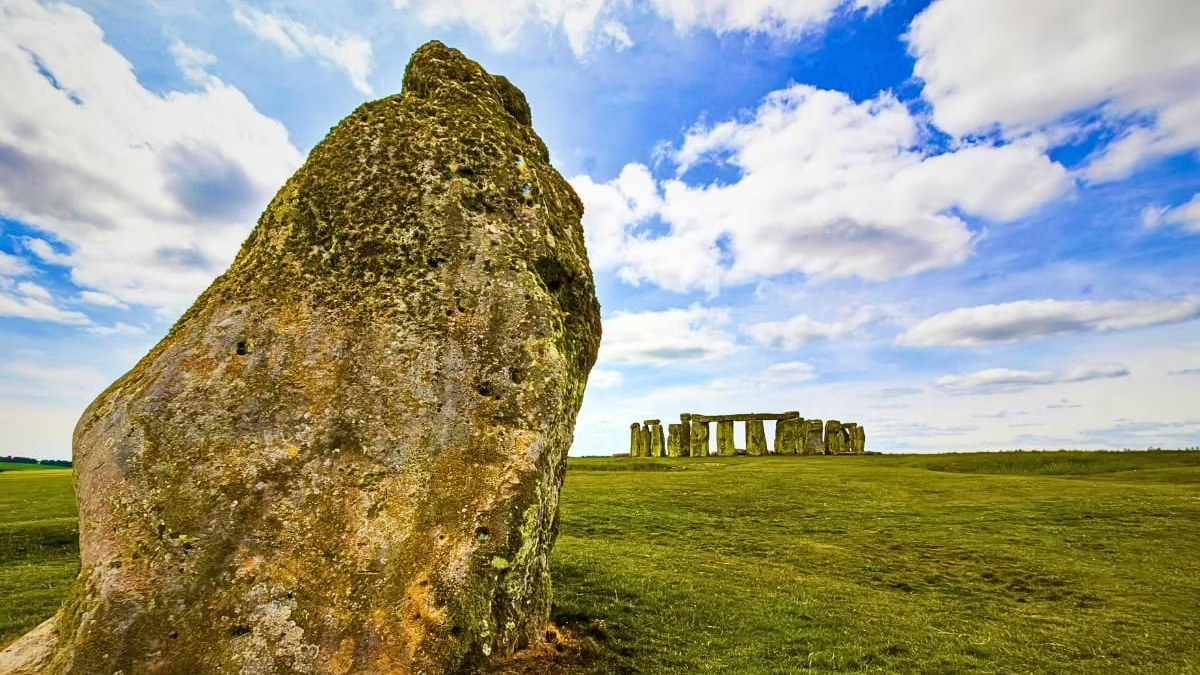
The Heel Stone is a rough, unworked sarsen standing 4.9 metres above ground north-east of the stone circle entrance. On the summer solstice, the sun rises approximately above it as seen from the centre of the monument — the most famous of Stonehenge’s solar alignments. Other key features include the trilithons (five pairs of massive sarsen uprights with lintels, forming a horseshoe inside the main circle), the Altar Stone (a fallen sandstone from Wales), the Slaughter Stone (a fallen sarsen near the entrance), the four Station Stones, and the Avenue (the ceremonial approach road).
Standing on the viewing path at Stonehenge, the visual impact of the monument is immediate — but understanding what you are looking at requires knowing the names and roles of its distinct elements. This guide introduces every key feature visible from the standard viewing path, explaining where each is, what it is made of, and what it tells us about the monument’s purpose and construction.
The Outer Earthwork
The outermost element of the Stonehenge monument is not the stones at all but a circular earthwork — a bank and ditch approximately 100 metres in diameter, dug around 3000 BCE using antler picks. The material excavated from the ditch was piled up to create an inner bank (the most substantial) and a smaller outer bank or counterscarp.
This earthwork is the oldest part of the monument and predates the famous stone circle by approximately 500 years. It establishes the circular boundary of the site and includes the Aubrey Holes (56 pits within the inner edge of the ditch, used for cremation burials in the monument’s earliest phase).
The Heel Stone
The Heel Stone is one of Stonehenge’s most famous individual elements — and one of the most misunderstood.
It is a large, unworked (undressed) sarsen standing approximately 4.9 metres above the ground north-east of the monument’s circular bank, beside the original entrance. Unlike the shaped sarsens of the circle and trilithons, the Heel Stone is rough and leaning slightly towards the monument. It weighs approximately 30 tonnes.
The solar alignment: If you stand at the centre of the stone circle on the summer solstice (around 21 June), the sun rises approximately above and to the left of the Heel Stone. In photographs, the sun appears to emerge from the stone’s crest or slightly to its left. Archaeological evidence suggests a second stone may once have stood beside the Heel Stone, and that the two stones together framed the midsummer sunrise more precisely.
The name: The origin of the name “Heel Stone” is uncertain. One explanation connects it to the Old English word heel (from Old English hælan, related to the idea of concealment or covering). Another derives it from a folk tale connecting it to the Devil striking a friar on the heel. The name is sometimes also given as “Friar’s Heel.” Neither etymology is conclusively established.
What it is not: The Heel Stone is not the stone on which the sun rises — the sun rises above the horizon beyond it, not from the stone itself. It is an alignment marker, not the source of the sunlight.
The Slaughter Stone
The Slaughter Stone is a large fallen sarsen lying just inside the entrance to the monument, near the Heel Stone. It is approximately 6.5 metres long and weighs around 6 tonnes.
The name is misleading — Victorian visitors assumed the reddish staining in the stone’s surface depressions was blood from ritual sacrifices. The staining is in fact caused by iron oxide (rust) from the sarsen’s iron minerals reacting with rainwater that pools in the natural surface depressions. There is no archaeological evidence for sacrifice at Stonehenge.
The Slaughter Stone was originally one of a pair of standing uprights forming a portal or gateway at the monument’s north-east entrance. Its partner has been lost. From the centre of the monument, looking north-east along the solstice axis, the Slaughter Stone and the missing partner would have framed the approach to the Heel Stone and the midsummer sunrise beyond.
The Avenue
The Avenue is a ceremonial approach road connecting Stonehenge to the River Avon, approximately 2.8 kilometres to the south-east. It consists of parallel banks and ditches approximately 12 metres apart, first built around 2300 BCE.
The Avenue’s straight final section — the last approximately 500 metres approaching Stonehenge — is aligned on exactly the same north-east to south-west axis as the monument itself: the axis of the midsummer sunrise and midwinter sunset. Recent excavations have revealed that this alignment was not entirely of human choosing — periglacial stripes (natural ridges and gullies created by repeated freezing and thawing of the ground during the last Ice Age) run in this direction beneath the Avenue, and it appears that Neolithic builders recognised and built along them, choosing Stonehenge’s site partly because of naturally occurring features that already pointed towards the solstice sunrise.
The Avenue is visible from the stone circle viewing path as a subtle linear earthwork extending north-east across the plain.
The Trilithons
The trilithons are the most architecturally impressive elements of Stonehenge — and the ones that give the monument its distinctive silhouette. A trilithon (from Greek, meaning “three stones”) consists of two massive upright sarsens topped by a single horizontal lintel, forming an open doorway or arch.
There are five trilithons at Stonehenge, arranged in a horseshoe shape open to the north-east, inside the outer sarsen circle. They are arranged in graduated height, with the tallest pair (the Great Trilithon) at the south-west end of the horseshoe, facing the midsummer sunrise axis.
The Great Trilithon (Stones 55, 56, and lintel 156): Originally the tallest structure in the monument, Stone 56 rises approximately 9.1 metres above ground (with more below). Stone 55, its partner, fell in antiquity and now lies broken on the ground. When both stood, this trilithon framed the midwinter sunset as seen from the monument’s north-east entrance.
Each trilithon upright was shaped to a tapered profile (wider at the base, narrower at the top) using hammerstones, and a tenon was carved at the top to fit the mortise carved into the underside of the lintel. The lintels were raised to their positions approximately 4.5–5 metres above the ground.
The Sarsen Circle
The outer sarsen circle originally consisted of 30 upright stones and 30 lintels forming a continuous horizontal ring — the only stone circle in the world known to have had a complete connected ring of lintels. Of the original 30 uprights, 17 remain standing. Of the 30 lintels, 9 remain in their original positions.
Each lintel was shaped to curve slightly along its length, so that together they formed a smooth circle. Adjacent lintels were connected by tongue-and-groove joints carved into their ends — the same type of joint used in woodworking.
The uprights of the outer circle taper slightly upwards (called entasis — a technique also used in classical Greek architecture to counteract optical illusion and make columns appear straight). The north-east section of the outer circle, facing the Avenue and the midsummer sunrise, was finished to a higher standard than the south-west section — its stones are more carefully shaped and the surfaces more smoothly dressed.
The Bluestone Circle and Horseshoe
Between the outer sarsen circle and the inner trilithon horseshoe stands the bluestone circle — approximately 43 remaining bluestones of varied geological composition, set as single uprights without lintels. These are the smaller, darker stones that give Stonehenge its two-material character.
Within the trilithon horseshoe, a corresponding inner horseshoe of bluestones mirrors the shape of the trilithons — these are the innermost stones at Stonehenge.
The bluestones have a complex history, having been moved and rearranged at least twice before settling in their current positions. Some are visibly shaped (with worked surfaces and tenons suggesting they were originally used as lintels or in a different structural configuration).
The Altar Stone
The Altar Stone is a large fallen sandstone slab lying beneath the fallen upright of the Great Trilithon, roughly at the centre of the monument. It is approximately 5 metres long and 1 metre thick, and appears to be made of a micaceous sandstone — a type not found in the local chalk downland.
Recent geological analysis has traced the Altar Stone’s origin to east Wales (the Brecon Beacons or Black Mountains area), making it a third type of stone at Stonehenge from a third distinct source. Its original role — whether it stood upright as a monolith or lay flat as a ground stone — is debated. The name “Altar Stone” was applied by the 17th-century architect Inigo Jones, who believed Stonehenge was a Roman temple; its association with an altar in any ritual sense is speculative.
The Station Stones
The four Station Stones are low sarsen blocks placed at roughly equal intervals near the inner edge of the surrounding ditch, forming the corners of a precise rectangle. Only two remain (Stones 91 and 93); the positions of the others (92 and 94) are known from records and earthwork evidence.
The rectangle’s long sides are parallel to the solstice alignment; its short sides are perpendicular to it. This means the Station Stones not only reinforce the monument’s solar orientation but also, at this specific latitude, align to significant lunar events (the major lunar standstill). The precision of this geometric relationship has led some astronomers to argue it was intentional.
The Aubrey Holes
The 56 Aubrey Holes are pits arranged in a ring just inside the inner edge of the surrounding ditch. Named after John Aubrey, who first identified them in 1666, they are among the earliest features of the monument, dating from the very first phase around 3000 BCE.
Their original function is debated. They may have held wooden posts; they may have held bluestones in Stonehenge’s first stone phase (which would mean bluestones arrived at the site earlier than the current evidence suggests). What is clear is that the Aubrey Holes were used for cremation burials — 64 cremated individuals have been recovered from the holes and the surrounding area, and the total buried may have been 150 or more.
The Z and Y Holes
Two concentric rings of pits — the Z holes (closer to the stones) and Y holes (further out) — were dug around the sarsen circle around 1800–1500 BCE. Radiocarbon dates from antlers found in the pits date to this period. Neither ring of pits was ever filled with stones, even though each pit was large enough to hold a substantial stone. Why these holes were prepared and then left empty is unknown — one of the many mysteries that Stonehenge continues to pose.
Frequently Asked Questions
What is the Heel Stone?
A large unworked sarsen standing north-east of the monument’s entrance, approximately 4.9 metres above ground. On the summer solstice, the sun rises approximately above it as seen from the centre of the monument.
What is a trilithon?
Three stones forming an arch — two uprights topped by a single lintel. There are five trilithons at Stonehenge, arranged in a horseshoe inside the main sarsen circle.
What is the Altar Stone?
A fallen sandstone slab at the centre of the monument, probably from east Wales. Its name was applied in the 17th century; its actual ritual function (if any) is unknown.
Why is it called the Slaughter Stone?
Victorian visitors assumed the reddish staining in its surface was blood from sacrifices. It is in fact iron oxide from the stone’s natural mineral composition reacting with rainwater. There is no evidence of ritual sacrifice at Stonehenge.
What are the Aubrey Holes?
Fifty-six pits arranged in a ring just inside the surrounding ditch, dating from around 3000 BCE. They were used for cremation burials. Their original structural purpose (whether they held posts or stones) is debated.
Can I see these features from the viewing path?
Yes — all features described in this guide are visible from the standard circular viewing path. The audio guide (free app, 12 languages) directs your attention to each of them in turn, making the most of the view available from the path.
