

Stonehenge at Sunrise & Solstice: What It’s Really Like
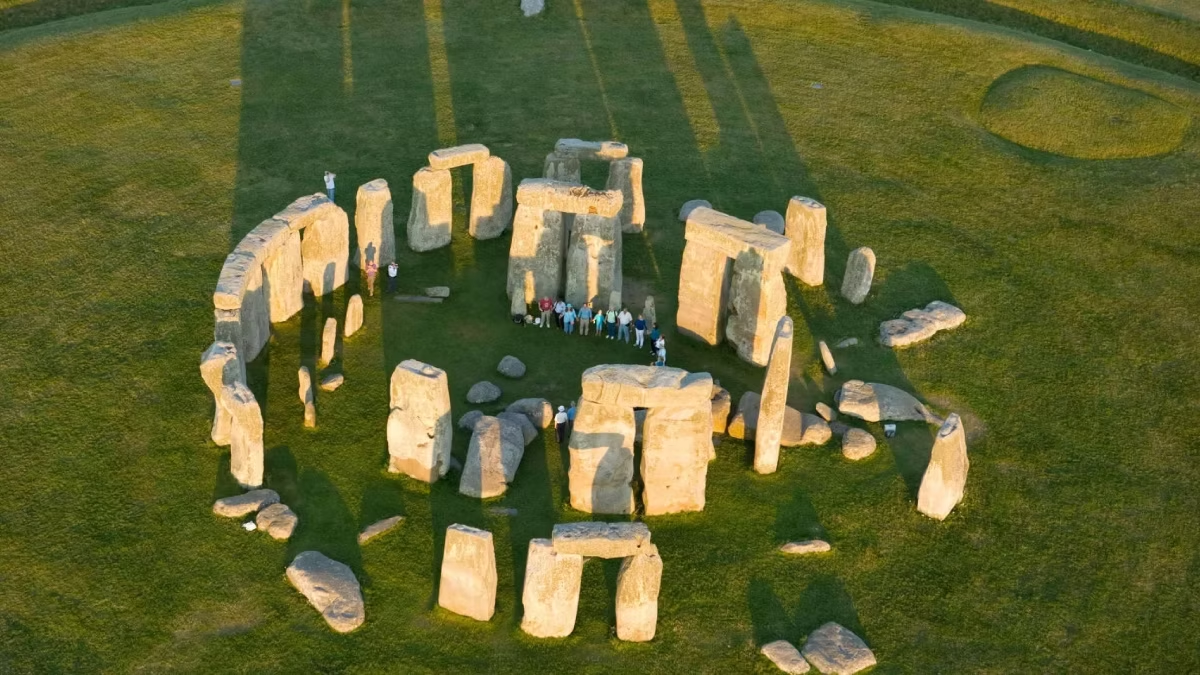
Stonehenge at sunrise during the Stone Circle Experience is a private, atmospheric, close-up encounter with the monument outside normal hours — limited to 52 people, priced at £70 for adults. The summer solstice (21 June 2026, sunrise approximately 4:52am) is a free mass public event with thousands of visitors and free access inside the stones. The winter solstice (21 December 2026, sunrise approximately 8:10am) is smaller, quieter, and equally atmospheric. Each is a fundamentally different experience from a standard daytime visit.
Three distinctly different ways to see Stonehenge at dawn or dusk — a private inner circle session, the midsummer solstice gathering, or the winter solstice celebration. Each offers something that no standard daytime visit can replicate. This guide explains what each is actually like, who each suits, and how to plan.
The Stone Circle Experience: A Private Sunrise or Sunset
The English Heritage Stone Circle Experience is a separate, premium booking that takes small groups of visitors inside the stone circle outside normal opening hours. Sessions take place at dawn or dusk, when the site is closed to the general public.
What it is:
- A guided session inside the stone circle lasting approximately one hour
- Available at dawn (early morning, before the site opens) or dusk (evening, after closing)
- Maximum 52 people per session, split into two groups of 26 at the stones
- Led by English Heritage guides who provide expert interpretation
- Priced at £70 for adults (18+), £40 for children aged 5–17; English Heritage member discounts apply
- Not available in October and November
- Now bookable through March 2027
What it feels like:
The absence of the general public is the defining quality. The shuttle bus arrives at the stones to find them silent and undisturbed. No visitors on the viewing path. No background hum from the shuttle, no distant voices. Just the monument, the open plain, and the light.
At dawn, the light arrives horizontally across the chalk downland, catching the sarsen surfaces and casting long shadows that trace the curvature of the stones in ways that overhead midday light cannot. The Heel Stone, which frames the midsummer sunrise from the monument’s centre, is most meaningful in this low light. At dusk, the same directional quality applies — the stones glow differently in the last hour of daylight than at any point during the day.
Inside the stone circle, what is most striking to most visitors is the scale. From the standard viewing path, the sarsens are impressive at distance. From inside, standing directly beneath a trilithon, they are overwhelming — the architecture of a monument that seems designed to dwarf the people within it.
For full booking and availability information: Stonehenge Sunrise and Sunset Special Access: Ticket Guide
Important note on timing: The Stone Circle Experience is not timed to coincide precisely with astronomical sunrise or sunset. It takes place when the site opens or closes to the public, which does not always align exactly with the sun’s position on the horizon. In midsummer, the sun may already be high by the time of the morning session; the actual sunrise over the Heel Stone occurs before 5am in June. The light is still exceptional, and the absence of crowds is unchanged — but manage expectations about seeing the sun rise precisely above the Heel Stone unless you attend the summer solstice (see below).
The Summer Solstice: 21 June 2026
The summer solstice at Stonehenge is one of the most distinctive annual events in England — and one of the most misunderstood by visitors planning to attend.
The key facts for 2026:
- Date: Sunday 21 June 2026
- Sunrise at Stonehenge: approximately 4:52am
- The astronomical solstice occurs earlier that morning
- Free public access — no ticket required
- Managed open access: visitors can walk among the stones around sunrise, not just observe from the viewing path
- Many people begin arriving between midnight and 2am
- No general public admission ticket is required; free access is granted
What it is like:
The summer solstice at Stonehenge is not a quiet, spiritual moment. It is a large, communal, very loud celebration. Tens of thousands of people gather on the night before the solstice, camping in fields near the monument, arriving by shuttle from the car parks, and walking across the plain in darkness. By the time sunrise approaches, the monument field is dense with people — Druids in white robes, neo-Pagans, tourists with cameras, families, party-goers, and people who have been there since midnight.
The sunrise itself is powerful. When conditions are right and the sky is clear, the sun rises above the horizon to the north-east and appears to emerge from above the Heel Stone as seen from within the circle — the alignment that Stonehenge was built to frame. The moment is genuinely moving, even in a crowd.
Who the summer solstice is for:
- People who want to experience Stonehenge as part of a community, in an atmosphere of celebration
- Anyone with an interest in neo-Druid, Pagan, or New Age traditions
- Photographers who want the midsummer sunrise alignment with the stones
- Visitors who have a high tolerance for crowds, early hours, and an unpredictable atmosphere
- Those for whom the occasion of being at Stonehenge on the longest day is the point, regardless of the conditions
Who the summer solstice is not for:
- Visitors who want a quiet, contemplative experience
- Those who want close-up photography without crowds
- Anyone arriving expecting the private Stone Circle Experience — this is a mass public event
- Families with young children unless the adults are experienced at large outdoor events with very early starts
Practical notes:
- Road closures and special parking arrangements apply — check the English Heritage website the week before
- No Visitor Centre facilities are available in the pre-dawn hours
- Bring warm clothing (even in June, pre-dawn temperatures on Salisbury Plain are cold), water, food, and a torch
- Security measures are in place; only small bags approximately 30cm × 25cm × 15cm are permitted in the monument field
- The specific arrangements for the 2026 summer solstice will be published on the English Heritage website
The Winter Solstice: 21 December 2026
The winter solstice at Stonehenge is the quieter, colder, and arguably more archaeologically authentic of the two solstice events. While the summer solstice draws tens of thousands, the winter event typically attracts hundreds to low thousands.
The key facts for 2026:
- Date: Monday 21 December 2026
- Sunrise at Stonehenge: approximately 8:10am
- Free public access around sunrise — similar managed open access to the summer event
- Much smaller crowd than the summer solstice
- More reflective atmosphere
Why the winter solstice may be more significant:
Many archaeologists believe the winter solstice — the shortest day, when the sun reaches its southernmost setting point — was the primary astronomical orientation of Stonehenge. The Great Trilithon frames the midwinter sunset as seen from the monument’s north-east entrance: the sun at its lowest and most fragile, at the moment when prehistoric farming communities most needed reassurance of its return. The summer solstice alignment is dramatic; the winter sunset alignment is arguably more meaningful.
The winter solstice at Stonehenge feels different from the summer event in almost every way. The crowd is smaller and quieter. The atmosphere is reflective rather than celebratory. The light is extraordinary — low and warm even as it rises. Druids and Pagan communities observe the solstice with ceremony, but the event is not dominated by their presence in the way the summer solstice is.
Practical notes:
- December temperatures at Stonehenge are typically 2–6°C; pre-dawn it can be significantly colder with wind chill
- Dress in multiple warm layers, waterproof outer layer, warm hat and gloves
- Bring a torch for the pre-dawn walk across the monument field
- Check the English Heritage website for 2026 specific arrangements
How the Three Experiences Compare
| Stone Circle Experience | Summer Solstice | Winter Solstice | |
|---|---|---|---|
| When | Dawn or dusk, year-round (not Oct–Nov) | 21 June, sunrise ~4:52am | 21 December, sunrise ~8:10am |
| Cost | £70 adults, £40 children | Free | Free |
| Group size | Max 52 | Tens of thousands | Hundreds to low thousands |
| Inside the stones? | Yes | Yes (open access) | Yes (open access) |
| Atmosphere | Quiet, intimate, guided | Mass celebration | Quiet, reflective |
| Photography | Exceptional (low angle light, no crowds) | Dramatic (crowds in frame) | Excellent (clear field, low light) |
| Planning difficulty | Book months ahead | Special transport arrangements | Simpler logistics than summer |
| Best for | Those who want solitude + astronomy | Community experience + midsummer alignment | Archaeology-minded visitors + quiet celebration |
Frequently Asked Questions
What time is sunrise at Stonehenge on the summer solstice 2026?
Approximately 4:52am on Sunday 21 June 2026.
Is it free to attend the summer solstice at Stonehenge?
Yes — the summer solstice is a free, managed open-access event. No ticket is required.
How many people attend the summer solstice at Stonehenge?
Tens of thousands, with many arriving in the small hours of the morning. The event can feel very crowded by the time sunrise arrives.
Does the sun actually rise over the Heel Stone?
At the summer solstice, the sun rises approximately above the Heel Stone as seen from the centre of the stone circle — slightly to the left of it rather than directly above. A second stone may once have stood beside the Heel Stone to frame the alignment more precisely. The effect is visible and the alignment is intentional, but it is not mathematically perfect from a single viewpoint.
Is the Stone Circle Experience the same as attending the solstice?
No. They are completely different experiences. The Stone Circle Experience is a small private guided session (max 52 people) outside normal hours. The solstice is a mass public gathering (tens of thousands) with free open access around the monument. The Stone Circle Experience offers intimacy and expert interpretation; the solstice offers atmosphere and communal experience.
Can I bring a drone to photograph the solstice?
No. Drones are strictly prohibited at Stonehenge on all occasions.
