

Stonehenge Myths, Legends & Theories: The Complete Guide
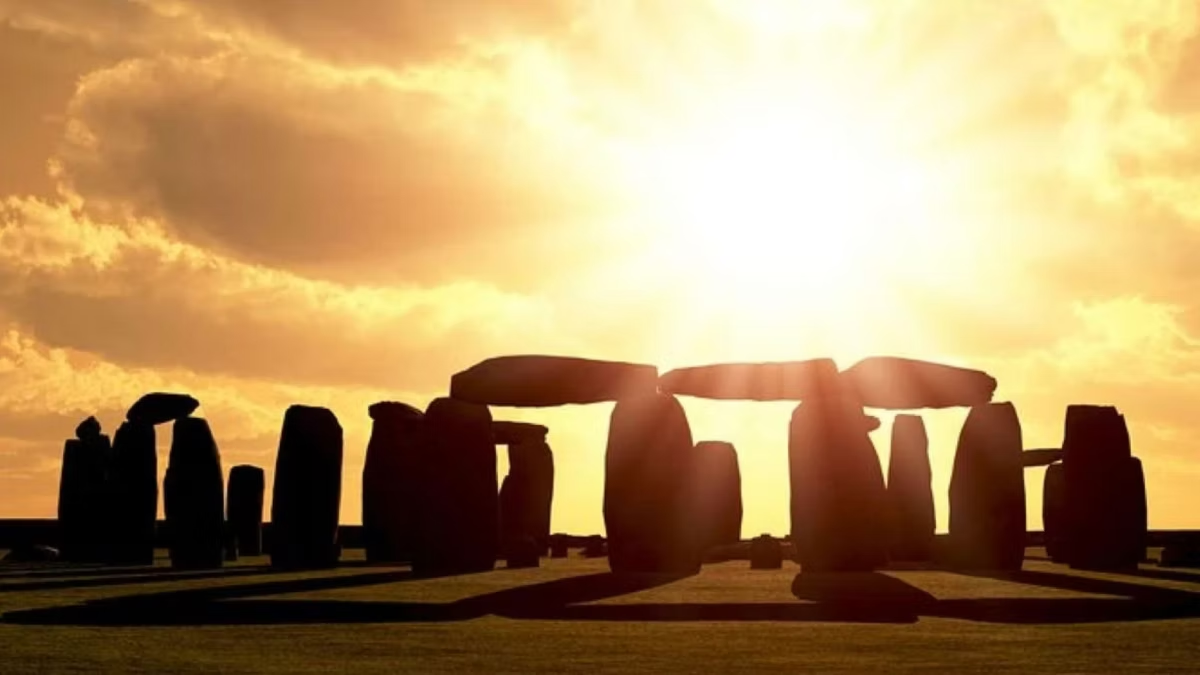
Stonehenge has attracted myths and theories for nearly 1,000 years. The most famous legends involve Merlin, Giants, Druids, and aliens — all of which archaeology has disproved or cannot support. The serious modern theories, based on excavation and scientific analysis, are: Stonehenge as an astronomical monument aligned with the solstices; as a burial ground and ancestor cult site; as a pilgrimage centre for healing; and as a monument of unity for Neolithic Britain. None of these theories is definitive — Stonehenge’s purpose remains genuinely uncertain.
Stonehenge has been misunderstood, romanticised, and mythologised for centuries. The legends surrounding it are often more revealing about the people who invented them than about the monument itself. At the same time, the serious scientific theories — developed over 400 years of careful archaeology — are in many ways stranger and more compelling than any legend. This guide covers both.
The Legends
Merlin and the Giants
The oldest written legend about Stonehenge’s origin comes from the 12th-century chronicler Geoffrey of Monmouth, whose Historia Regum Britanniae (c.1136) tells a story of Merlin, the wizard of Arthurian legend. According to Geoffrey, hundreds of British nobles had been massacred by Saxons and buried on Salisbury Plain. King Aurelius Ambrosius wished to honour them with a fitting monument. On Merlin’s advice, an army was sent to Ireland to collect a magical stone circle known as the Giants’ Dance, which giants had supposedly brought from Africa. The Irish army prevented this, and Merlin himself used his power to dismantle the stones and transport them to Salisbury Plain, where he reassembled them as Stonehenge.
Geoffrey’s account was influential enough that for centuries, Stonehenge was associated with Arthurian Britain and Merlin. Later retellings embellished it: in some versions Merlin simply cast a spell; in others he commanded a giant to carry the stones. The monument’s earlier name in some medieval sources — Chorea Gigantum, or “Giants’ Dance” — reinforced this association.
What archaeology says: The sarsens came from West Woods, 25 kilometres to the north. The bluestones came from the Preseli Hills in Wales, 240 kilometres away. Human transport, using sledges, rollers, rafts, and ropes, is the overwhelming consensus. No archaeological evidence exists for Arthurian or magical origins.
The Druids
The Druid theory is probably the most enduring and widely believed myth about Stonehenge — and one of the most thoroughly disproven. It originated in the 17th century with the antiquarian John Aubrey, who in the 1660s was the first to conduct a systematic survey of the monument. Aubrey suggested Stonehenge was a Druid temple. His successor William Stukeley enthusiastically developed this theory in the 18th century, even adopting Druidic rituals himself.
The problem is one of dates. Historical Druids — the priestly class described by Julius Caesar and other Roman writers — appeared in Britain in the Iron Age, approximately 300–200 BCE. Stonehenge was built and largely complete between 3000 and 1500 BCE — a full 1,000 to 2,500 years before any historically recorded Druids existed in Britain.
Modern archaeologists are clear: Druids did not build Stonehenge. The monument predates them by centuries. The Druid-Stonehenge connection was created in the 17th and 18th centuries and bears no relationship to the monument’s actual builders.
What is true is that Stonehenge has accumulated spiritual significance across many communities over its long history. Modern neo-Druid groups, established in the 20th century, do gather at Stonehenge for solstice celebrations. The historian Ronald Hutton has noted the irony: “It was a great irony that modern Druids had arrived at Stonehenge just as archaeologists were evicting the ancient Druids from it.” Contemporary Druid and Pagan communities’ connection to the monument is real and meaningful to those communities — it is simply 2,000+ years more recent than medieval legend suggests.
The Romans
In 1655 the architect Inigo Jones, who had been commissioned by King James I to survey Stonehenge, published his conclusion that it was a Roman temple, built in the Tuscan architectural order and dedicated to Caelus, the sky god. Jones found the geometry and symmetry so impressive that he could not believe prehistoric people were capable of building it — and so attributed it to Rome’s more recent and better-documented civilisation.
Jones was wrong. Stonehenge predates the Roman presence in Britain by over 1,500 years. His survey was nonetheless useful — it produced some of the earliest measured drawings of the monument.
Giants
Medieval sources consistently associate Stonehenge with giants — beings of superhuman strength who alone could have moved stones of this size. The “Giants’ Dance” name persisted for centuries. The idea that an extinct race of giants built Stonehenge appears regularly in modern conspiracy literature alongside the alien theory.
What archaeology says: The stones were moved by organised teams of hundreds of ordinary people using wooden sledges, rollers, ropes, and levers. Experimental archaeology has repeatedly demonstrated the feasibility of this. The builders were not superhuman — they were skilled, organised, and persistent.
Aliens
The alien theory takes multiple forms: Stonehenge as a spacecraft landing pad, as an interstellar navigation beacon, as the work of an advanced alien civilisation assisting primitive humans who could not otherwise have built it. This theory implicitly argues that Neolithic people were incapable of the engineering and organisation required.
What archaeology says: Neolithic communities were capable of extraordinary feats of engineering and social organisation. The same people who built Stonehenge also built Avebury (16 times its area), the Cursus (3 kilometres long), West Kennet Long Barrow, and Durrington Walls (a settlement of potentially 4,000 people). There is no archaeological evidence for extraterrestrial involvement at Stonehenge or anywhere else.
Healing Stones
This is one of the older and more persistent folk beliefs — that the stones of Stonehenge had healing properties. Medieval texts describe pilgrims bringing the sick to Stonehenge, and the water poured over the stones was believed to cure illness. The association is strong enough that some modern archaeologists have used it as the basis for a serious theory (see below).
The “Cannot Be Counted” Myth
A persistent folk legend holds that Stonehenge’s stones cannot be accurately counted — that different people always get different totals, or that the stones multiply when you try to count them. This is a charming story with no basis in fact. The monument’s stones are fixed and countable (approximately 93 remain). The legend appears to have originated in the medieval period as an expression of the monument’s otherworldly character.
Ley Lines and Energy
From the early 20th century onwards, Stonehenge has featured prominently in theories about ley lines — hypothetical alignments of sacred sites across the landscape, proposed by Alfred Watkins in 1921. More recent New Age interpretations suggest that Stonehenge sits at the intersection of earth energy lines and that the stones concentrate or channel natural forces.
What archaeology says: The solstice alignment of Stonehenge is archaeologically real and clearly intentional. The broader ley line theory has no scientific support — the apparent alignment of sites across the landscape is a product of the density of ancient monuments in southern England combined with selective data selection.
The Serious Theories: What Archaeologists Actually Believe
After 400 years of excavation and scientific analysis, archaeology has produced a set of evidence-based theories for Stonehenge’s purpose. None is definitively proven, and most archaeologists believe multiple explanations are simultaneously true.
1. An Astronomical Monument
The most certain fact about Stonehenge’s purpose is that it is deliberately oriented toward the sun. The monument is aligned along a north-east to south-west axis that corresponds precisely to the midsummer sunrise (from the centre looking north-east) and the midwinter sunset (looking south-west). The Avenue, the Heel Stone, and the Great Trilithon all participate in this alignment. The Station Stones mark a rectangle whose sides also relate to significant solar and lunar events at this latitude.
The farming communities who built Stonehenge depended on knowledge of the seasons for survival. The solstices — the turning points of the agricultural year — were of immense practical and likely spiritual significance. The monument encoded this astronomical knowledge in stone.
2. A Cemetery and Ancestor Cult Site
Stonehenge was a significant burial ground from its earliest phase. Approximately 150 people were cremated and buried at the site between 3000 and 2300 BCE — making it the largest late Neolithic cemetery in the British Isles. The human remains show diverse origins including some individuals from Wales — the same region as the bluestones.
Mike Parker Pearson (UCL Institute of Archaeology) has proposed that Stonehenge was a domain of the dead — a monument in permanent stone representing the world of ancestors, as counterpart to the nearby timber circle at Durrington Walls (representing the world of the living). The processional route along the River Avon and the Avenue connected the two, with the journey symbolising a passage from life to death.
3. A Healing Centre
Tim Darvill and Geoffrey Wainwright, following excavations between 2008 and 2010, proposed that Stonehenge was a prehistoric Lourdes — a pilgrimage centre for healing. Evidence includes the presence of human remains showing signs of injuries and diseases; the discovery of the Amesbury Archer (an Early Bronze Age man with a damaged knee) near the site; and the later medieval belief in the stones’ healing properties, which may reflect a much older tradition. The transport of bluestones from Wales may have been motivated by their perceived medicinal or spiritual properties at their source.
4. A Monument of Unity
Parker Pearson has also proposed, based on isotope analysis showing people from across Britain converging on Stonehenge, that the monument was built as a symbol of national unity — a communal project at a moment when Britain’s scattered Neolithic communities were undergoing cultural convergence. The enormous shared effort of building Stonehenge may itself have been the point, as much as whatever ceremonies were conducted within it.
5. A Territory Marker
Some archaeologists view Stonehenge as a fixed point at the intersection of adjacent prehistoric territories, serving as a seasonal gathering place for groups that spent most of the year dispersed across the lowland landscape to east and west. The monument would have served as a shared focal point for exchange, marriage alliance, dispute resolution, and ceremony.
The Myth That Stonehenge Is Overrated
This is perhaps the most modern myth — the suggestion circulating on travel forums that Stonehenge is disappointing, too small, or not worth the admission price. It is usually attributed to people who arrived with a mental image shaped by dramatic photographs from low angles, and were surprised to find the stones do not rise to the height of a skyscraper.
The sarsens are, in reality, approximately 9 metres tall (roughly 3 storeys), weighing up to 30 tonnes. They are extremely large. The viewing path brings you within 10 metres. The archaeological context provided by the Visitor Centre — over 250 objects, a 360-degree audio-visual theatre, reconstructed Neolithic houses — transforms the experience considerably for visitors who engage with it. Stonehenge visited with some prior knowledge and a reasonable engagement with the audio guide consistently delivers. The stone circle is, by any objective measure, extraordinary.
Frequently Asked Questions
Did the Druids build Stonehenge?
No. Stonehenge was built between 3000 and 1500 BCE. Historical Druids appeared in Britain around 300–200 BCE — more than 1,000 years after Stonehenge was largely complete. The Druid theory was invented in the 17th century. Modern Druidic communities do gather at Stonehenge, but they did not build it.
Did Merlin build Stonehenge?
No. This legend was first written down by Geoffrey of Monmouth in the 12th century CE. Stonehenge was built more than 3,000 years before Geoffrey’s time, by Neolithic farming communities using stone, bone, and wooden tools.
Did aliens build Stonehenge?
No. There is no scientific evidence for extraterrestrial involvement. The builders were Neolithic and Bronze Age communities who demonstrated extraordinary organisational, engineering, and logistical capability. The same communities built dozens of comparable monuments across prehistoric Britain.
Was Stonehenge a Roman temple?
No. Stonehenge predates the Roman presence in Britain by approximately 1,500 years. The Roman theory was proposed by Inigo Jones in the 17th century and has been comprehensively disproven by archaeological dating.
What is the real purpose of Stonehenge?
Archaeology points to multiple simultaneous purposes: a monument aligned with the solstices, a burial ground and cemetery, possibly a healing and pilgrimage centre, and a site of communal gathering for communities across prehistoric Britain. No single explanation is definitively proven, and Stonehenge’s meaning may have evolved significantly over the 1,500 years of its construction and use.
