

Stonehenge Photography Guide: Best Spots, Times & Tips (2026)
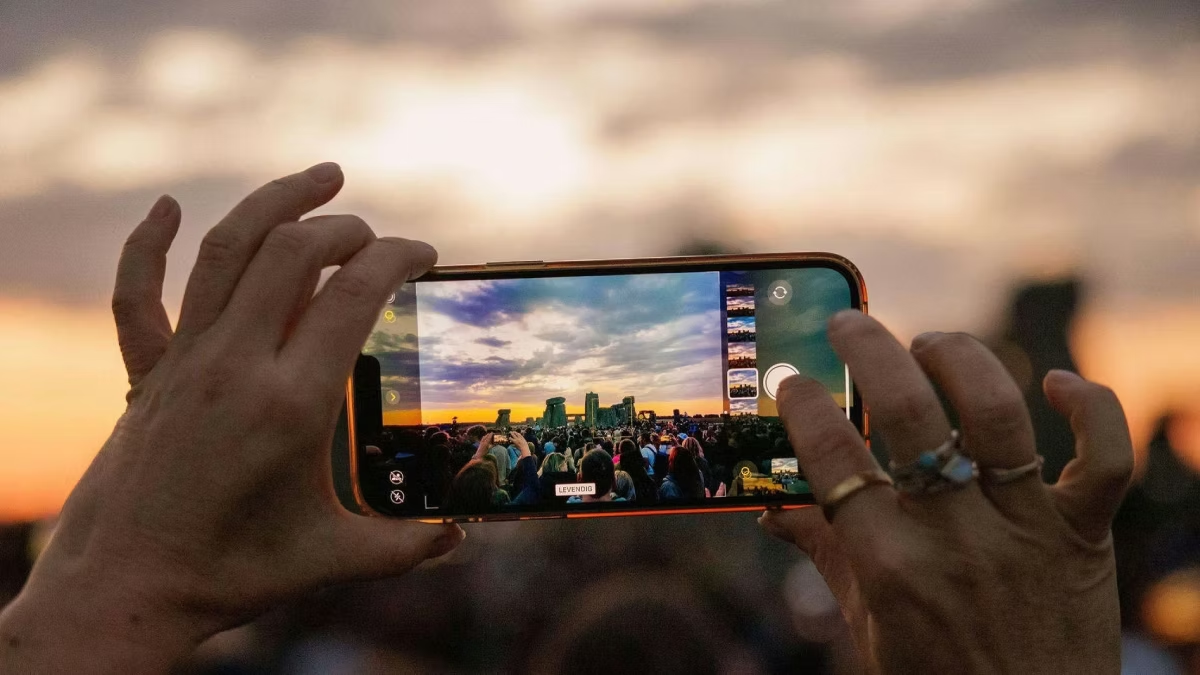
The best times to photograph Stonehenge are early morning (9:30am opening slot in spring or autumn) for soft directional light and minimal crowds, and during inner circle access sessions at dawn or dusk for close-up shots without restrictions. From the standard viewing path, low-angle morning or late afternoon light produces the best results. Drones are strictly prohibited. Commercial photography requires prior permission from English Heritage. Overcast skies often produce better results than bright sunshine.
Stonehenge is one of the most photographed monuments in the world — which means that getting an original, high-quality photograph requires thought rather than just pointing a camera at the stones. This guide covers the practical realities of photographing Stonehenge from the standard viewing path, and the exceptional opportunity that inner circle access provides.
The Rules First
Personal photography is permitted throughout the site — on the viewing path, in the Visitor Centre, around the Neolithic houses, and in the wider National Trust landscape. No permit is required for personal photography.
Drones are strictly prohibited at Stonehenge and in the surrounding landscape. Flying a drone over the site is not permitted under any circumstances.
Commercial photography and professional shoots require prior permission from English Heritage. This includes photography for advertising, editorial publication, television, or film. Contact English Heritage’s filming and photography team in advance.
Tripods are permitted in most areas of the site. At the stone circle, tripod use may be restricted during busy periods to avoid obstructing other visitors.
The Honest Reality of the Standard Visit
From the standard circular viewing path, you are approximately 10 metres from the outer ring of sarsens. This is close enough to see the individual stones clearly and appreciate their scale, and far enough that a standard smartphone lens can frame the whole monument comfortably.
What you cannot do from the standard path:
- Stand inside the stone circle
- Get within touching distance of any stone
- Frame shots from ground level inside the horseshoe of trilithons
- Photograph the interior arrangement from within the circle
What you can do:
- Walk the complete circumference and photograph the monument from all angles
- Use a telephoto lens to isolate individual stone details — the tenon joints, the tooling marks on the sarsen surfaces, the weathering patterns
- Use a wide-angle lens to capture the monument in its landscape setting
- Photograph the monument from the walking route across the plain, which gives a more natural relationship between Stonehenge and its environment than the managed visitor path
The most common photographic frustration on a standard visit is other people. The viewing path is narrow and continuous, and at peak times the density of visitors makes it difficult to frame shots without other people in the foreground or background. The strategies for managing this are described below.
The Best Times to Photograph Stonehenge
Best: Inner Circle Access (Dawn or Dusk)
If photography is a primary motivation for your visit, inner circle access at dawn or dusk is categorically better than any standard visit. The reasons are cumulative:
- No other visitors on the viewing path or inside the circle
- Close-up framing from inside the horseshoe of trilithons — impossible from the standard path
- Low-angle morning or evening light that catches the textured sarsen surfaces
- The dramatic perspective of looking up at the Great Trilithon from directly beneath it
- Dawn mist on autumn and winter mornings is a frequent bonus
The Stone Circle Experience (£70 adults) provides guided access. Commercially operated inner circle tours from London provide the same access as part of a day or evening itinerary.
For booking options:
Stonehenge Sunrise and Sunset Special Access
Excellent: Early Morning, Standard Visit (9:30am Opening Slot)
The 9:30am time slot on a weekday delivers the best photography conditions available on a standard admission ticket:
- Fewer visitors on the viewing path than any later slot
- Morning light angles across the sarsens from the north-east, creating directional shadow and texture
- The first shuttle bus arrives before the first London coach tours
- In autumn and winter, morning mist on the plain is possible
Good: Late Afternoon (from 3pm–4pm)
As the day’s coach tours complete their visits and return to London, the viewing path quietens from mid-afternoon. In summer, afternoon light from the south-west illuminates the stones differently from morning light. In autumn, late afternoon light can be warm and directional. Last entry is 3pm (winter) or 4pm (summer) — don’t leave arrival too late.
Avoid: Midday in Summer (11am–2pm)
This window brings the highest concentration of visitors, the most overhead and flat light, and the least favourable conditions for either composition or crowd management.
Best Seasons for Photography
Autumn (September–October) — best overall
The combination of lower visitor numbers, warm afternoon light, and the possibility of morning mist on the plain makes early autumn the strongest season for landscape and monument photography. The autumn light is lower in angle than summer and warmer in quality.
Winter (November–March) — best for atmosphere
Winter photography at Stonehenge, particularly on clear days, delivers extraordinary light quality. The sun remains low throughout the day, casting long shadows across the sarsens at any time. Without summer’s overhead sun, the stones’ textures and shapes are emphasised. Frost and cold clear skies produce some of the most dramatic Stonehenge photographs ever taken. The compromise is shorter opening hours and higher chance of poor weather.
Spring (April–June) — good for greenery and flowers
The surrounding chalk grassland flowers in spring, giving the landscape context a different character. Visitor numbers are lower than summer. Morning light in April–May is excellent.
Summer (July–August) — best for long days, hardest for crowds
The solstice alignment photography is only possible in midsummer. Extended daylight hours mean golden hour photography is possible well into the evening. The compromise is the highest crowd levels of the year.
Equipment and Settings
Cameras
- Smartphone: Perfectly adequate for standard-path photography in good light. Most modern phones handle the wide viewing-path compositions well.
- Mirrorless or DSLR: Provides better low-light performance, more control over depth of field, and better telephoto capability for stone detail shots.
- Wide-angle lens (16–35mm equivalent): Useful for capturing the whole circle and the landscape in a single frame.
- Telephoto (70–200mm equivalent): Useful for isolating individual stones, the Heel Stone alignment, and stone surface details visible from the path.
For Inner Circle Access
- A camera with good low-light performance is strongly recommended — dawn sessions involve shooting in very low ambient light before the sun rises above the horizon.
- A tripod allows long exposures in low light — useful for pre-dawn and post-sunset sessions.
- A remote shutter release or 2-second timer avoids camera shake on long exposures.
Settings Advice
- Overcast light: Use a standard exposure; overcast skies produce even, diffused light that flatters the stone surfaces. Do not underexpose.
- Golden hour: Use exposure compensation to protect highlights; the warm directional light renders beautifully on the sarsen surfaces.
- Shooting into the sun (Heel Stone alignment): Use exposure compensation to manage the strong backlight; shoot in RAW if possible for post-processing flexibility.
- Low-light dawn/dusk: ISO 800–3200 depending on your camera’s noise performance; aperture f/4–f/8 for sharpness across multiple stones; shutter speed as slow as camera stability allows.
Composition Tips
Include the landscape. Stonehenge in its Salisbury Plain setting — wide chalk grassland, big sky, the stones as a relatively small but powerful element — is often more arresting than a tight frame of just the stones. The monument’s scale is communicated by its relationship to the landscape around it.
Use the path’s geometry. The circular viewing path creates natural leading lines that can be used to draw the eye towards the monument. A low-angle shot down the gravel path towards the stones is a classic and effective composition.
Wait for gaps in the crowd. In peak hours, the path is crowded enough that clean compositions are difficult. Be patient — there are usually brief windows when the immediate foreground clears. Early morning reduces the time you need to wait.
Use the Heel Stone alignment. Standing on the north-east side of the circle, framing the stones with the Heel Stone in the foreground or background, references the monument’s most famous solar alignment. In the right light, this composition is one of the most powerful at Stonehenge.
Shoot from the walk, not just the path. The walking route from the Visitor Centre to the stones passes through the National Trust landscape and offers perspectives on the monument from different distances and angles that the circular path itself does not. The approach from the north-east along the Avenue is particularly evocative.
Practical Tips
Battery management. Cold winter mornings drain batteries faster than warm summer ones. Carry a spare battery for winter photography sessions.
Weather protection. Rain is possible at any season. A light rain jacket for yourself and a camera rain cover (or a plastic bag) protect your equipment during showers.
Download the audio guide before arrival. The Stonehenge Audio Tour app is free and identifies named features around the path. Knowing what you are photographing (the Heel Stone, the Great Trilithon, the Slaughter Stone) adds meaning to compositions.
Golden hour timing. Summer sunrise at Stonehenge is around 4:52am on the solstice, rising to approximately 5:30–6:00am by late June. A 9:30am visit in summer misses golden hour entirely. Autumn and winter sunrise is later and more compatible with the site’s opening time — late October sunrise is around 7:30am, giving beautiful pre-opening light that the 9:30am slot catches well.
Frequently Asked Questions
Can I use a tripod at Stonehenge?
Yes — tripods are permitted. During busy periods, staff may ask you to move if a tripod is obstructing the narrow viewing path. Morning slots and inner circle sessions have the most freedom for tripod use.
Can I fly a drone over Stonehenge?
No. Drones are strictly prohibited.
Is commercial photography allowed at Stonehenge?
Commercial photography (for advertising, publication, television, or film) requires prior permission from English Heritage. Personal photography does not.
What is the best time of day to photograph Stonehenge?
From the standard viewing path: early morning (9:30am opening slot) gives the best combination of good light and fewer crowds. For the best photography overall: inner circle access at dawn — the combination of close-up access and low-angle light is unmatched.
Can I photograph inside the stone circle?
Only during Stone Circle Experience sessions and solstice open access events, both of which take place outside normal visiting hours. Photography inside the circle during inner circle access is permitted and encouraged.
