

The Stones: Types, Origins & How They Got There
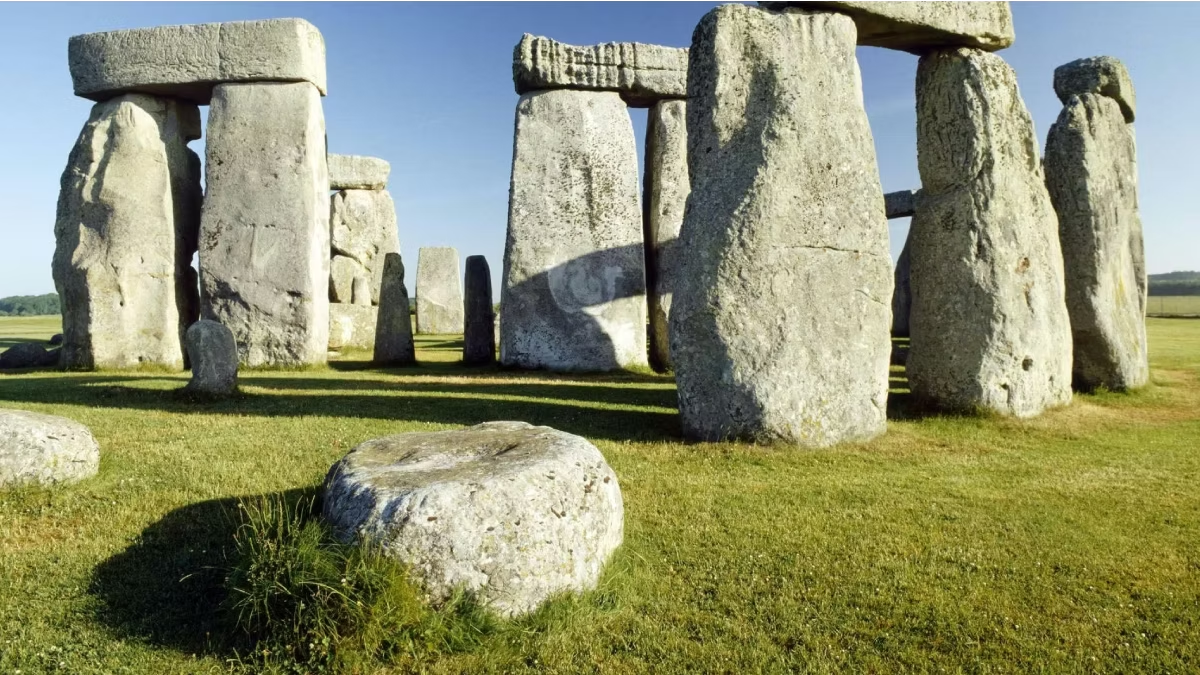
Stonehenge has two main types of stone: sarsens (large sandstone blocks averaging 25 tonnes, sourced from West Woods near Marlborough, approximately 25km away) and bluestones (smaller igneous stones averaging 2–4 tonnes, sourced from the Preseli Hills in southwest Wales, approximately 240km away). The sarsens form the outer circle and inner trilithon horseshoe. The bluestones form the inner circle and inner horseshoe. Construction used mortise-and-tenon and tongue-and-groove joinery. The largest stone weighs approximately 30 tonnes.
Standing in front of Stonehenge, the most immediate question is: how? How did Neolithic people move stones of this size, across these distances, without wheels, without iron tools, without horses? The answer involves a level of planning, coordination, and engineering skill that transforms the monument from a curiosity into one of the most impressive feats of human organisation in prehistory.
The Two Types of Stone
Stonehenge contains two fundamentally different types of stone, brought from two completely different origins and used in distinct structural roles.
The Sarsens
Sarsens are the large, grey-brown sandstone blocks that form Stonehenge’s iconic silhouette — the tall uprights and horizontal lintels of the outer circle, and the five massive trilithons of the inner horseshoe. “Sarsen” is a vernacular term for silcrete, a type of hard sandstone formed when silica cements sand grains together. Sarsens are found scattered across southern England, but the most extensive natural concentrations are on the Marlborough Downs in Wiltshire.
Key sarsen facts:
- Average weight of an upright: approximately 25 tonnes
- The largest upright (Stone 56, part of the Great Trilithon): approximately 9.1 metres long above ground and possibly 8 tonnes more below ground
- The largest overall weight: the fallen Stone 54, estimated at approximately 30 tonnes above ground
- Original number of sarsens at the outer circle: 30 uprights and 30 lintels
- Number of sarsens remaining today: 52 (of an original approximately 80)
Where did the sarsens come from?
For centuries, the Marlborough Downs (approximately 30km north of Stonehenge) were assumed to be the source. In 2020, geochemical analysis published in Science Advances confirmed this with much greater precision. Using portable X-ray fluorescence spectrometry on all 52 remaining sarsens, researchers found that 50 of them share a consistent chemical signature. Comparison with sarsen samples from across southern Britain identified West Woods — on the edge of the Marlborough Downs, approximately 25km north of Stonehenge — as the most probable source for the majority. Two sarsens have a different chemical signature and may have come from a different source; this remains under investigation.
The Bluestones
Bluestones are the smaller, darker stones that stand between the sarsens — in an outer circle between the sarsen uprights, and in an inner horseshoe within the trilithons. The term “bluestone” is a collective name for stones of varied geology (dolerites, rhyolites, tuffs, and sandstones) that are all clearly not local to Salisbury Plain. They have a bluish tinge when freshly broken or wet.
Key bluestone facts:
- Weight: approximately 2–4 tonnes each (with some exceptions)
- Original number: approximately 80 bluestones were used at Stonehenge
- Remaining today: approximately 43 (including both standing and fallen)
- The Altar Stone (a large sandstone, now fallen): approximately 6 tonnes; probably came from east Wales
Where did the bluestones come from?
The bluestones come from the Preseli Hills in southwest Wales, approximately 240km from Stonehenge — one of the most remarkable transportation achievements of the prehistoric world. Specific quarry sites have been identified through geological analysis:
- Carn Goedog and Craig Rhos-y-felin in the Preseli Hills have been confirmed as quarry sources for the spotted dolerite bluestones. Radiocarbon dating of the quarry activity dates these to approximately 3400–3200 BCE — 300–500 years before the bluestones appeared at Stonehenge.
- The quarry at Waun Mawn, also in the Preseli Hills, may have been a predecessor stone circle whose stones were dismantled and relocated to Stonehenge around 3000 BCE — in effect, Stonehenge may have been built partly from a deconstructed Welsh monument.
- The Altar Stone’s origin has been traced to east Wales (the Brecon Beacons or Black Mountains area).
Why the builders chose stones from this specific location in Wales — 240km away — when local sarsens were available much closer remains one of Stonehenge’s most compelling unsolved questions.
How Were the Stones Transported?
Moving the Bluestones from Wales
The transport of bluestones from the Preseli Hills to Stonehenge involved both land and water. The most widely accepted route combines:
- Quarrying in the Preseli Hills
- Land transport to the Welsh coast (possibly using wooden sledges on wooden rollers or log rails)
- Sea or coastal transport around the southwestern tip of Wales
- River transport along the Bristol Channel and possibly the rivers Avon and Frome into Wiltshire
- Final overland transport to Stonehenge
An average bluestone weighs approximately 2 tonnes. Experimental archaeology has shown that stones of this size can be moved by small groups of people using wooden frames, levers, ropes, and sledges — laborious and slow, but achievable without wheeled transport or draft animals. The total distance involved, approximately 220–240km by the likely route, remains one of the most impressive logistical achievements of any prehistoric society.
Moving the Sarsens from West Woods
The sarsens presented a different challenge: similar distance (approximately 25km) but dramatically greater weight (25 tonnes on average). The most likely transport method was:
- Large oak sledges, constructed to distribute the stone’s weight across a wide base
- Rolling on wooden rollers or sliding on wooden rails (to reduce friction)
- Teams of hundreds of people pulling with plant-fibre ropes
- Carefully prepared routes across the landscape — a 25km route for a 25-tonne stone on an oak sledge would have required continuous maintenance to prevent the sledge sinking into soft ground
Experimental archaeology in the 20th century demonstrated the feasibility of moving large sarsens by human effort alone — though the scale of what the Stonehenge builders achieved, moving over 80 stones of this size, remains extraordinary. The degree of pre-planning required (route surveys, timber felling for sledges and tracks, organisation of labour across perhaps hundreds of kilometres and multiple seasons) points to a society with sophisticated political and logistical capacity.
How Were the Stones Shaped?
The sarsens at Stonehenge are not natural boulders — they were shaped to precise specifications using stone tools.
Hammerstones — large flint and sarsen hammers — were used to pound the surfaces of the stones into shape. Thousands of hammerstones and fragments of dressed stone have been found in the field north of Stonehenge, where the shaping appears to have been done on arrival at the site.
Mortise-and-tenon joints were carved into the upright sarsens and their lintels: a circular projection (tenon) on top of each upright fits into a corresponding hollow (mortise) carved into the underside of each lintel. These joints are normally associated with woodworking, and their use in stone represents a remarkable transfer of carpentry technique to an entirely different material.
Tongue-and-groove joints were carved along the edges of adjacent lintels, locking each horizontal stone to its neighbours to form a continuous ring. This is the only known prehistoric stone monument to use both types of joint.
The inner faces of the trilithons and the north-east section of the outer circle were finished to a higher standard than other areas — possibly because these surfaces faced the direction of approach along the Avenue, or because they were most visible from inside the monument.
How Were the Stones Raised?
Erecting a 25-tonne stone required a method for both tilting the upright into a prepared hole and then lifting the lintel to its position several metres above the ground.
Raising the uprights: A large hole was dug with a sloping side and lined with wooden stakes to protect the hole’s edges. The stone was moved to the lip of the hole and then levered and tilted forward using wooden A-frames, levers, and ropes, until it fell into a near-vertical position in the hole. Earth and chalk rubble were then packed tightly around the base to hold the stone upright.
Raising the lintels: The method for lifting lintels to the tops of the uprights (approximately 4.5 metres above ground for the outer circle) is debated. The most plausible reconstruction involves a timber crib — a gradually raised platform of interlocking wooden logs — with the lintel being raised incrementally using levers as layers of logs are added beneath it. Once the lintel reaches the height of the uprights’ tops, it is slid sideways into its final position on the tenons.
The Bluestone History at Stonehenge
The bluestones have a more complex history than the sarsens. They were not simply brought to Stonehenge and left in their current positions. Archaeological evidence shows they were moved and rearranged multiple times over approximately 1,000 years:
- Around 2500 BCE: the bluestones are first erected at Stonehenge in a double arc arrangement
- Around 2200–1900 BCE: the bluestones are removed and re-erected in their current circle and inner horseshoe configuration
- The Q and R holes (now empty) and the Aubrey Holes (originally used for cremation burials, later possibly used to hold bluestones) represent earlier phases of the monument’s bluestone story
Some archaeologists have proposed that the bluestones came to Stonehenge from a pre-existing stone circle in Wales — specifically the Waun Mawn circle in the Preseli Hills, whose stones were dismantled around 3000 BCE around the time Stonehenge’s early phases were beginning. This would mean Stonehenge inherited sacred stones from an older monument — a form of physical and spiritual continuity rather than a building project starting from scratch.
Frequently Asked Questions
How many stones are at Stonehenge?
Approximately 95 stones remain (standing and fallen) of what may have been around 160 originally. The exact original number is debated because some stones may have been removed so long ago that no evidence remains of their former presence.
What type of rock are the Stonehenge stones?
The large sarsens are silcrete (a hard sandstone). The bluestones are of varied geology — primarily dolerite (an igneous rock), with some rhyolite, tuff, and sandstone. The Altar Stone is a type of sandstone from east Wales.
How heavy are the Stonehenge stones?
Sarsens average approximately 25 tonnes; the largest is estimated at 30+ tonnes. Bluestones average 2–4 tonnes each.
How far did the stones travel?
Sarsens: approximately 25km from West Woods near Marlborough. Bluestones: approximately 240km from the Preseli Hills in southwest Wales. The Altar Stone: approximately 250km from east Wales.
Did glaciers bring the bluestones to Stonehenge?
This theory (that Ice Age glaciers transported the bluestones partway to Salisbury Plain) was proposed by some geologists but is not the consensus. Evidence of Neolithic quarrying at specific Welsh sites (Craig Rhos-y-felin, Carn Goedog) and the lack of evidence for glacial deposition in southern central England strongly supports human transport rather than glacial action.
How were the mortise-and-tenon joints carved in stone?
Using flint and sarsen hammerstones, which were used to pound the stone surfaces repeatedly until the required shape was achieved. This was an extremely labour-intensive process, but the quality of the joinery — still visible on the fallen stones where the joints are accessible — demonstrates a high level of skill and precision.
