

What Is Stonehenge? History, Facts & Why It Was Built
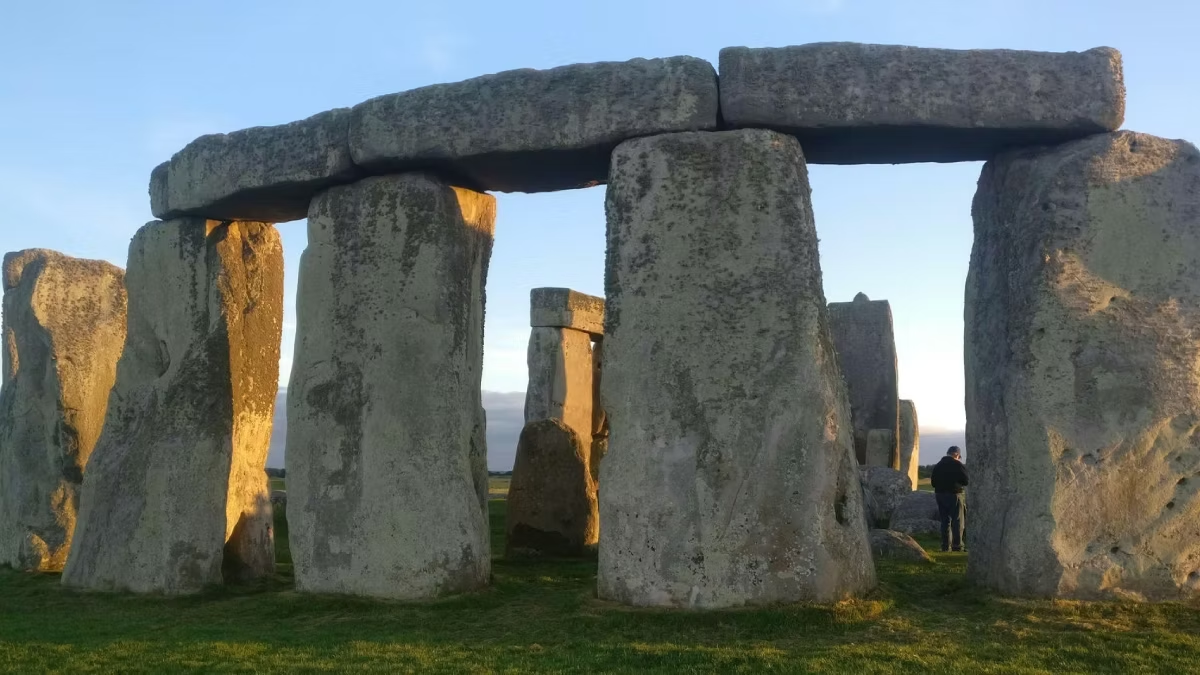
Stonehenge is a prehistoric stone circle monument on Salisbury Plain in Wiltshire, England, built in stages between approximately 3000 BCE and 1500 BCE by Neolithic and Bronze Age communities. It is a UNESCO World Heritage Site, visited by around one million people annually. Its purpose is unknown with certainty, but archaeological evidence points to its use as a ceremonial site, a burial ground, and a monument aligned with the movements of the sun — particularly the midsummer sunrise and midwinter sunset.
Of all the monuments on Earth, Stonehenge may be the one that inspires the greatest volume of questions. How was it built? Why was it built? Who built it? Why here? Why these stones, brought from such distances? The answers that archaeology has produced over 400 years of research are extraordinary — and the questions that remain are, if anything, more fascinating than those that have been answered.
The Basic Facts
Location: Near Amesbury, Wiltshire, England. Approximately 145 kilometres west of London; 15 kilometres north of Salisbury.
Age: Construction began around 3000 BCE and continued in distinct phases for approximately 1,500 years. The famous stone circle as it appears today was largely complete by around 1500 BCE — making it older than the Pyramids of Giza.
UNESCO status: World Heritage Site since 1986. Part of the Stonehenge, Avebury and Associated Sites designation.
Ownership: The Crown Estate owns the stones; English Heritage manages the site. The surrounding land is owned and managed by the National Trust.
Visitors: Approximately one million per year.
The name: The word Stonehenge is Old English. Its most widely accepted derivation combines stān (stone) with henge (derived from either “hinge” — referring to the way lintels are fitted — or “hanging/suspended stones”). The “henge” in Stonehenge has since given its name to a whole class of Neolithic monuments.
Who Built Stonehenge?
No single group of people built Stonehenge. The monument was constructed and modified over approximately 1,500 years by multiple successive communities. Modern historians and archaeologists broadly agree on the following:
The first builders (around 3000 BCE) were Neolithic farming communities indigenous to the British Isles. They dug the circular earthwork bank and ditch that forms the outermost boundary of the Stonehenge complex, using simple antler picks. Within this enclosure they created 56 pits — the Aubrey Holes — which were used for cremation burials. Stonehenge was, from its earliest phase, a significant funerary site. At least 150 individuals were cremated and buried here between 3000 and 2300 BCE, making it the largest late Neolithic cemetery in the British Isles.
Later builders (around 2500 BCE) erected the enormous sarsen stones that form the monument’s iconic silhouette — the outer circle and the five trilithon pairs of the inner horseshoe. These builders appear to have come from the European continent or to have been part of a culture with strong continental connections (evidenced by the “Beaker” pottery associated with this period). Recent genetic analysis suggests the Neolithic population of Britain was largely replaced around this time by migrants from the European steppe — though the relationship between these population movements and Stonehenge’s construction remains complex and debated.
The Amesbury Archer — an Early Bronze Age skeleton excavated 3 kilometres from Stonehenge, dating to approximately 2300 BCE — is the most famous individual associated with this later period. His grave was exceptionally rich (the richest Early Bronze Age burial found in Britain), suggesting the area around Stonehenge was a place of extraordinary importance for communities across a wide region.
When Was It Built? The Construction Phases
Stonehenge was not built at once. It was a multi-generational project, modified repeatedly over 1,500 years.
Phase 1 — around 3000 BCE: Circular earthwork enclosure (bank and ditch, approximately 100 metres in diameter). Aubrey Holes (56 pits for posts or bluestones). Used as a cremation cemetery.
Phase 2 — around 2500 BCE: The bluestones are erected. These smaller stones, averaging 2–4 tonnes each, were transported from the Preseli Hills in southwest Wales — a distance of approximately 240 kilometres. Their arrival at Stonehenge represents one of the most remarkable feats of prehistoric logistics in the world. Why these specific stones, from this specific location in Wales, were chosen remains one of Stonehenge’s deepest mysteries.
Phase 3 — around 2500–2400 BCE: The sarsen stones are erected. The 30 uprights of the outer circle and the 10 uprights and 5 lintels of the inner trilithon horseshoe are raised. These enormous sandstone blocks — averaging 25 tonnes, with the largest approaching 30 tonnes — were transported approximately 25 kilometres from West Woods near Marlborough. Their shaping uses woodworking joints (mortise-and-tenon on the uprights and tenon-lintel connections; tongue-and-groove between adjacent lintels) that represent the highest precision stone-working known from prehistoric Britain.
Later modifications — approximately 2200–1500 BCE: The bluestones are rearranged multiple times into their current positions (an outer circle between the sarsen uprights and an inner horseshoe within the trilithons). Two concentric rings of pits — the Y and Z holes — are dug around the stone settings but never filled with stones. Activity at the monument gradually declines.
Why Was Stonehenge Built?
This is the question that has occupied archaeologists, astronomers, historians, and dreamers for four centuries. There is no single agreed answer. The evidence points to multiple purposes, and Stonehenge’s meaning likely evolved as the monument was built and modified over 1,500 years.
The astronomical alignment. The most certain fact is that Stonehenge is deliberately aligned with the movements of the sun. If you stand at the centre of the monument on the longest day of the year (around 21 June), the sun rises directly above the Heel Stone to the north-east. On the shortest day (around 21 December), the sun sets in the south-west, framing the central trilithon. This bidirectional solar alignment — midsummer sunrise / midwinter sunset — was not accidental. The Avenue leading from Stonehenge to the River Avon is also aligned on this solar axis. The monument was oriented to track the extremes of the sun’s annual movement with extraordinary precision.
A burial ground. Stonehenge was a significant cemetery for much of its early history. At least 150 cremated individuals were buried here between 3000 and 2300 BCE. The bones of some of these individuals show signs of being brought from Wales — the same region as the bluestones. Mike Parker Pearson of the Stonehenge Riverside Project has suggested that Stonehenge may have been a “domain of the dead” — a monument in stone (the permanent, ancestral material) as counterpart to the nearby timber circle at Durrington Walls (the domain of the living). The procession between Durrington Walls and Stonehenge, along the river and the Avenue, may have been a ritual journey from life to death.
A place of healing. Isotope analysis of the human remains found at Stonehenge and in the surrounding area shows that some individuals came from far afield to this place. Tim Darvill and Geoffrey Wainwright have proposed that Stonehenge was a prehistoric healing centre, comparable to Lourdes — a destination of pilgrimage for those seeking cures, drawn by the bluestones’ reputed medicinal properties. The Amesbury Archer, found with a damaged knee, is cited as possible supporting evidence.
A monument to unity. Mike Parker Pearson has also proposed, based on isotope evidence showing people travelling to Stonehenge from across Britain, that the monument may have been built as a symbol of national unity at a time when Britain’s Neolithic communities were undergoing cultural convergence.
A calendar. The monument’s solar alignments made it capable of marking the solstices — the critical turning points of the agricultural year. For farming communities for whom the seasons governed everything — planting, harvesting, the movement of animals — knowledge of the solstices was practically essential.
The Theories: From Druids to Aliens
Stonehenge has attracted every imaginable theory over the centuries.
Merlin: The 12th-century chronicler Geoffrey of Monmouth attributed Stonehenge to the wizard Merlin, who supposedly transported the stones from Ireland. This legend persisted for centuries.
The Druids: 17th and 18th century antiquarians including John Aubrey and William Stukeley believed Stonehenge was a Druid temple. This idea remains deeply embedded in popular culture, and modern Druids still regard Stonehenge as a sacred site. The archaeological reality is that Stonehenge predates the historical Druids by at least 2,000 years. However, the monument certainly held religious significance for Bronze Age and later Iron Age communities, and the continuity of significance at this place across millennia is itself remarkable.
Aliens: A persistent non-scientific theory. It underestimates the extraordinary intelligence and organisational capacity of Neolithic and Bronze Age people, for whom large-scale collective projects — including the transportation of 25-tonne stones without wheeled vehicles — were achievable through coordinated human effort and sophisticated planning.
Romans: The architect Inigo Jones, commissioned by King James I to survey Stonehenge, concluded it was a Roman temple. He was wrong, but his misidentification illustrates how genuinely baffling the monument was to scholarly observers even in the 17th century.
The Archaeological Landscape
Stonehenge does not stand alone. The World Heritage Site designation covers a landscape rich in prehistoric monuments:
- Durrington Walls — the settlement of the Stonehenge builders, 3km north-east, where evidence of large-scale feasting and gathering has been found
- Woodhenge — a timber circle just south of Durrington Walls, oriented to align with the rising midsummer sun
- The Cursus — a 3km Neolithic earthwork running east-west north of Stonehenge, predating the stone circle
- King Barrows and Normanton Down barrows — Bronze Age burial mounds on the ridges surrounding Stonehenge, many containing rich grave goods
- The Avenue — a ceremonial approach road connecting Stonehenge to the River Avon
- Avebury — the world’s largest henge, 30km north, nearly 1,000 years older than Stonehenge and 16 times its area
Understanding Stonehenge requires understanding this landscape — the monument was not built in isolation but as part of a sacred geography that was continually developed and modified over thousands of years.
Frequently Asked Questions
How old is Stonehenge?
The earliest construction began around 3000 BCE — making it approximately 5,000 years old. The famous stone circle was completed around 1500 BCE.
Who built Stonehenge?
Multiple generations of Neolithic and Bronze Age communities. The earthwork enclosure was built around 3000 BCE by indigenous Neolithic farmers. The sarsen stone circle was erected around 2500–2400 BCE, possibly by communities with connections to Continental Europe.
Why was Stonehenge built?
This remains unknown with certainty. Archaeological evidence suggests multiple purposes: a ceremonial site aligned with the solstices, a burial ground and cemetery, possibly a healing centre or pilgrimage destination, and a monument representing the meeting of different communities. No single theory has been definitively proven.
How were the stones moved?
The sarsens (25 tonnes each) were transported approximately 25km from West Woods on oak sledges, requiring hundreds of people. The bluestones (2–4 tonnes each) were transported approximately 240km from the Preseli Hills in Wales — a journey involving both land and sea transport. The exact methods remain partially debated, but human agency is the consensus explanation.
Why are the bluestones from Wales?
This remains one of Stonehenge’s deepest mysteries. The specific quarries in the Preseli Hills have been identified, and evidence suggests human transport rather than glacial movement. Why these specific stones, from this specific location 240km away, were chosen is unknown. Some hypotheses suggest the bluestones had symbolic or healing significance associated with their Welsh source.
Did the Druids build Stonehenge?
No. Stonehenge predates the historical Druids by approximately 2,000 years. The monument was built by Neolithic and Bronze Age communities. However, the site has held religious and spiritual significance for many communities across its 5,000-year history, including modern Druids and Pagan groups.
